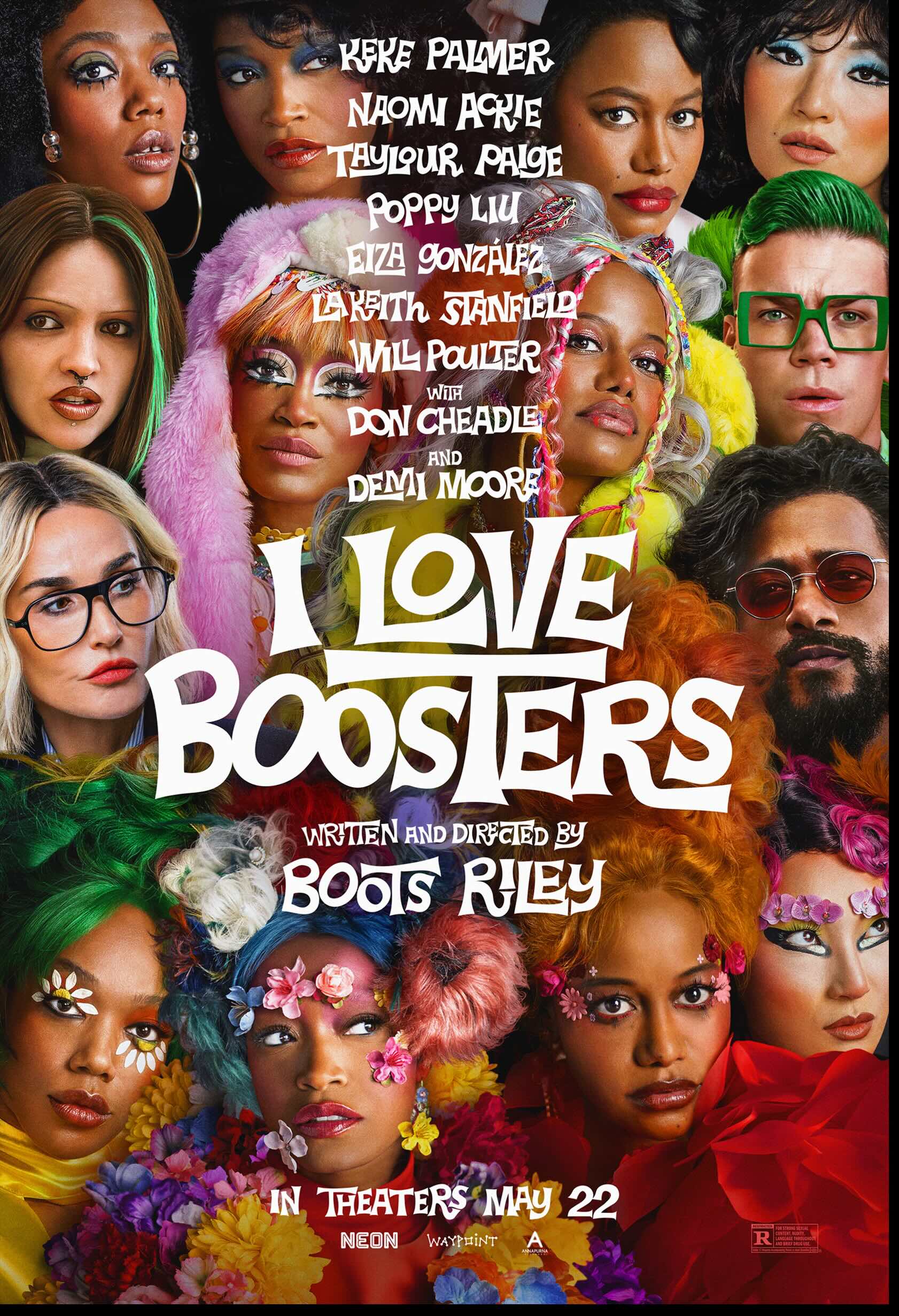
Boots Riley’s I Love Boosters looks poised to deliver one of the most visually daring and socially charged film experiences of 2026. Known for bringing sharp political commentary, absurdist humor, and unforgettable style to the screen, Riley once again steps into bold territory with a film that fuses surreal satire, fashion-world excess, and anti-capitalist energy into one electrifying narrative. With Keke Palmer at the center of the action and Demi Moore cast as a ruthless fashion mogul, I Love Boosters already feels like a title set to spark conversation across film, fashion, and culture circles.
At its core, I Love Boosters is a dystopian satire wrapped in candy-colored rebellion. The story follows a crew of shoplifters known as The Velvet Gang, led by Keke Palmer, as they challenge a tyrannical luxury empire built on inequality, manipulation, and image control. Their mission begins with stealing designer goods for resale, but the movement soon grows into something far larger—an uprising tied to workers, survival, and power. It is a premise that feels playful on the surface, yet deeply pointed underneath.
Boots Riley has built a reputation for making films that are not afraid to provoke. In I Love Boosters, that signature edge appears to be fully intact. The film takes the fantasy of luxury consumption and turns it upside down, asking what happens when the people at the bottom of the system start reclaiming value from the top. Instead of treating fashion as untouchable glamour, Riley uses it as both weapon and symbol—something to be stolen, reshaped, and redistributed. That reversal gives the film a stylish but radical heartbeat.
Keke Palmer is an especially exciting choice to lead this kind of story. She brings charisma, humor, unpredictability, and emotional range, all of which seem ideal for a character navigating a world where theft becomes activism and rebellion becomes spectacle. Palmer has the kind of screen presence that can ground a surreal universe while still matching its energy, and her role as the leader of The Velvet Gang could become one of the most talked-about performances tied to the film’s release.
Demi Moore’s presence as the film’s fashion mogul adds another compelling layer. She is the embodiment of power, image, and control in a world obsessed with status and surfaces. That dynamic sets up a rich contrast between Palmer’s disruptive, street-smart revolutionary force and Moore’s polished, elite authority. The clash between these two energies promises to be more than a standard good-versus-evil setup. It reflects a larger cultural tension between those who profit from exclusivity and those who refuse to stay locked outside of it.
What makes I Love Boosters particularly intriguing is its tonal blend. This is not simply a heist movie, nor is it just a social message film. It appears to combine:
- Surreal comedy
- Dystopian world-building
- Fashion-fueled visual spectacle
- Anti-capitalist satire
- Heist-style mischief and rebellion
- Worker-centered political themes
That mix gives the film crossover appeal. It can attract audiences who love bold aesthetics and unconventional storytelling, while also resonating with viewers drawn to stories about class, resistance, and collective power. Riley’s work often thrives in that tension between entertainment and critique, and I Love Boosters sounds ready to continue that creative tradition.
Visually, the phrase “candy-colored dystopian satire” already paints a strong editorial picture. It suggests a world bursting with pop visuals, exaggerated fashion, glossy excess, and dreamlike absurdity—all contrasted by deeper systems of oppression and exploitation. That kind of visual language could make the film especially appealing to audiences in the fashion and design community, where the interplay between beauty and critique often carries enormous power. Riley appears to be using color and style not just for flair, but to sharpen the irony of the world he is exposing.
The film’s social themes also make it timely. In an era when conversations around worker rights, economic pressure, luxury branding, and consumer culture continue to dominate headlines, I Love Boosters taps into a real-world frustration many audiences will recognize. By centering a crew that steals designer goods and inadvertently ignites a movement, the film positions rebellion not as polished heroism, but as something messy, clever, and rooted in necessity. That gives the story urgency beyond its satire.
Some of the most compelling reasons I Love Boosters stands out include:
- A fresh, original concept that merges fashion, crime, and cultural critique
- Boots Riley’s fearless storytelling style, known for mixing humor with deeper social commentary
- Keke Palmer in a commanding lead role that feels dynamic, bold, and unpredictable
- Demi Moore as a powerful antagonist, adding glamour and menace to the narrative
- Themes of class, labor, resistance, and redistribution woven into an imaginative dystopian framework
- A visually rich cinematic identity that could make the film a standout in 2026
Ultimately, I Love Boosters feels like far more than a quirky dystopian caper. It is shaping up to be a layered film about power, possession, and who gets to control the narrative of luxury in a broken world. With Boots Riley at the helm, audiences can likely expect something strange, stylish, funny, and politically alive. That combination alone makes this one of the more intriguing films on the horizon.
For viewers who appreciate cinema that dares to be visually wild and intellectually charged, I Love Boosters may arrive as both a fashion-fueled fantasy and a sharp cultural mirror. In true Boots Riley fashion, it seems ready to entertain while also asking uncomfortable questions—and that is often where the most unforgettable films begin.